Steam power
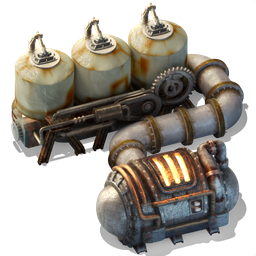
Overview
Steam power is a basic method of electricity generation that requires both water and burnable fuel. In Factorio, a standard steam power setup consists of an Offshore pump supplying water to Boilers, Boilers producing steam, and Steam Engines converting that steam into electrical energy while Electric Poles collect and distribute the produced electricity. Any burnable fuel (for example, coal) can be used in the Boilers to heat water and create steam.
Place the Offshore Pump in water and connect the Boilers to the pump. Attach Steam Engines to the Boilers and place an Electric Pole within the Steam engine’s supply range so generated electricity is delivered to the network. One Boiler produces sufficient heat to power two Steam Engines, and multiple Steam Engines may be connected to the same Boiler chain to scale output. Pipes can be used to route fluids and save space in compact setups.
Steam in Factorio stores energy proportional to its temperature, using a fixed storage value of 200 Joules per fluid unit per degree Celsius above ambient. Boiler-produced steam has a temperature of 165°C, while heat exchangers produce steam at 500°C; higher-temperature steam contains more energy per unit volume. Engines and turbines are mechanically modeled as 100% efficient at converting the stored thermal energy of steam into electrical energy, so the energy put into producing steam is the same energy available for generation, subject to temperature and device limits. If steam temperature is below the optimal operating temperature of a Steam Engine or turbine, the output is reduced but no energy is lost; if steam temperature exceeds a device’s maximum, any extra energy above that device’s limit is discarded. Because energy per unit of steam depends on temperature, using higher-temperature steam increases energy density and reduces the fluid throughput required for the same power.
The concepts of energy, work, power, efficiency, and losses are applicable when designing power systems. Energy is the capacity to do work and is measured in Joules. Work is the transfer or conversion of energy and is also measured in Joules. Power is the rate at which work is done or energy is produced and is measured in Watts (1 W = 1 J/s). Efficiency is the ratio of useful work produced to energy consumed and is a dimensionless fraction usually shown as a percentage. Losses are the difference between consumed energy and useful work produced.
Practical notes:
- Required components: Offshore Pump, Boiler, Steam Engine, fuel (coal or other burnable), and Electric Poles.
- One Boiler supports two Steam Engines; plan boiler-to-engine ratios accordingly.
- Arrange Boilers and Engines with pipes to manage space and ensure consistent water/steam flow.
- Higher-temperature steam stores more energy per unit; heat exchangers producing 500°C steam provide far greater energy density than boilers at 165°C.
- Steam fills storage tanks from the top down and is the only non-liquid fluid; steam cannot be stored in barrels.
- Keep Steam Engines within range of Electric Poles so generated power is integrated into the grid.
References to this (6)
Other entities of this type
- Advanced asteroid processing
- Advanced circuit
- Advanced combinators
- Advanced material processing
- Advanced oil processing
- Agricultural science pack
- Agriculture
- Artificial soil
- Artillery
- Artillery shell damage
- Artillery shell range
- Artillery shell shooting speed
- Asteroid productivity
- Asteroid reprocessing
- Atomic bomb
- Automated rail transportation
- Automation
- Automation science pack
- Automobilism
- Bacteria cultivation
- Battery
- Personal battery
- Personal battery MK2
- Personal battery MK3
... +163 (see sidebar for full list)