Steam Turbine
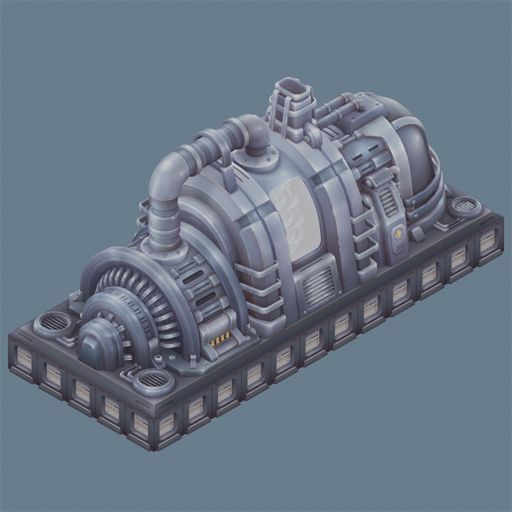
Overview
Steam Turbine is a building that converts high-pressure steam into electrical power. Each Steam Turbine produces a maximum of 3.6 MW when supplied with the required steam flow, and it is used as the primary generator in mid- to late-stage thermal power setups where Boilers produce steam from fuel.
A single Steam Turbine requires 60 Litres per second (L/s) of steam to operate at its maximum output of 3.6 MW. Because a Boiler is capable of supplying 60 L/s of steam at full output, one Boiler is sufficient to feed one Steam Turbine at full load. The Boiler must itself be driven with the appropriate fuel or heat source to sustain the steam flow required by the turbine.
Practical notes and interactions:
- Match Boilers to Turbines on a 1:1 basis when planning for full 3.6 MW output per Turbine. Undersupplying steam reduces the Turbine’s output proportionally.
- Balance pipe and conduit capacity so that 60 L/s of steam can reach the Turbine without losses from throttling or excessive branching.
- When scaling power generation, replicate Boiler–Steam Turbine pairs rather than trying to aggregate multiple Turbines onto a single Boiler unless an intermediary steam buffer and sufficient Boiler output are present.
- Monitor the energy input to Boilers: a Boiler needs to supply 60 L/s of steam, which corresponds to the Boiler’s own required heat/power input to maintain that steam production rate.
Because primary documentation for Steam Turbine specifics is limited in the available sources, this entry focuses on the confirmed steam flow and power relationship and its direct implication for Boiler pairing and plant layout.
Made by (1)
References to this (6)
Other entities of this type
- Advanced Smelter
- Assembler I
- Assembler II
- Assembler III
- Assembly Line Merger
- Assembly Line Painter
- Assembly Line Producer
- Assembly Line Rail
- Assembly Line Splitter
- Assembly Line Start
- Battery (Large)
- Battery (Small)
- Biomass Burner
- Boiler
- Burner Generator
- Cargo Ship Start Pad
- Cargo Ship Start Pad (Liquids)
- Cargo Ship Target Pad
- Cargo Ship Target Pad (Liquids)
- Casting Machine
- Chemical Processor
- Construction Ship Port
- Construction Warehouse
- Container
- Conveyor Balancer I
- Conveyor Balancer II
- Conveyor Balancer III
- Conveyor Balancer IV
- Conveyor I
- Conveyor II
... +72 (see sidebar for full list)