Gas Grass
Overview
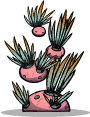
Gas Grass is a domesticated plant used almost exclusively as feed for Gassy Moo. When a Gassy Moo eats harvested Gas Grass, it excretes Natural Gas at a very high conversion rate, making the plant the core of renewable Natural Gas production chains. It can be grown in a Planter Box, Farm Tile, or Hydroponic Farm, though the Hydroponic Farm is preferred because it can be irrigated with 500 g of Liquid Chlorine per cycle.
A domestic Gas Grass takes 4 cycles to grow, while wild Gas Grass takes 16 cycles. It requires a temperature range of -273.2 °C to 75 °C, air pressure of up to 10 kg, and 10,000 Lux of light. It must be planted in the Space Biome or under a Sun Lamp to receive enough light. Gas Grass does not produce seeds on its own; in the base game, seeds are obtained only through space missions to the Organic Mass with a Biological Cargo Bay. In Spaced Out, it can generate seeds, but only on the Gassy moonlet.
Because its growth requires intense illumination, the main challenge is keeping the farm bright enough without wasting the gas you are trying to turn into fuel. Natural Gas absorbs the most light among the gases involved in a typical Gas Grass farm, followed by Chlorine, Carbon Dioxide, and Polluted Oxygen, so it is common to displace the farm area with Oxygen when using space lighting. Oxygen absorbs no light, making it the least disruptive filling gas. Sun Lamps and large Shine Bug setups can provide the needed light, but both are expensive in their own way; the Sun Lamp usually costs more power than the farm returns.
In practice, Gas Grass is used as the plant half of a chlorine-to-natural-gas conversion system:
- One cycle of growth produces 1 kg of harvested Gas Grass for a Gassy Moo.
- Gassy Moo excretion yields 500% of the consumed mass as Natural Gas.
- This works out to a 1:10 conversion rate, or 10 kg of Natural Gas per 1 kg of Liquid Chlorine consumed.
- Roughly 11 Gas Grass plants are needed to fully fuel a Natural Gas Generator running nonstop.
This makes Gas Grass an effective way to turn a Chlorine source, especially a Chlorine Vent, into a much larger Natural Gas supply, but it requires continuous care: cooling the chlorine input, maintaining the plants and critters, and providing enough light for growth.
References to this (11)
Other entities of this type
- Alveo Vera
- Arbor Tree
- Balm Lily
- Bliss Burst
- Bluff Briar
- Bog Bucket
- Bonbon Tree
- Bristle Blossom
- Buddy Bud
- Buried Muckroot
- Carved Lumen Quartz
- Dasha Saltvine
- Dew Dripper
- Dusk Cap
- Grubfruit Plant
- Guide/Agriculture
- Hexalent
- Hydrocactus
- Idylla Flower
- Jumping Joya
- Lura Plant
- Mealwood
- Megafrond
- Mellow Mallow
... +23 (see sidebar for full list)