Radioactive Biome
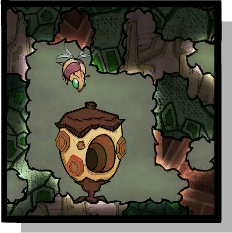
Overview
The Radioactive Biome is a hazardous biome centered around radiation exposure and radioactive resources. It is notable for containing Beetas, which can sting Duplicants if they come into contact with them, even through an Atmo Suit. The biome is also cold enough to matter for planning, but frostbite is usually less of an issue than the local wildlife and radiation hazards.
A common approach is to avoid extensive early harvesting and leave the biome mostly untouched until its materials are needed. Beetas are especially valuable because they are the most efficient source of the biome’s key resources, and they can remove material from natural tiles at full efficiency, compared to a Duplicant’s lower excavation efficiency. If you do need to work in the biome, minimizing direct contact with Beetas is important; pneumatic doors are useful for limiting exposure, and running the game at higher speed can reduce the practical impact of critter behavior, though that depends on hardware and is not something to rely on.
Radiation management is a major part of working in or near this biome. Most materials block radiation to some extent, including gases, but Airflow Tiles, Mesh Tiles, and Solar Panels do not block radiation at all. Duplicants absorb radiation based on the tile their feet occupy, so the material underfoot matters as much as nearby sources. Lead Suits reduce radiation absorption by 66%, and Seafood grants a temporary radiation resistance effect that further reduces absorption; the two effects stack. Duplicants can also reduce their absorbed dose by using the bathroom, and repeated bathroom breaks can noticeably lower accumulated radiation over a cycle. If a Duplicant absorbs too much radiation, they may develop Radiation Sickness.
The biome can be a source of several kinds of radiation-bearing materials and emissions. Radioactive contaminants irradiate only the tile they occupy, whether that tile contains a solid, liquid, or gas, but they do not radiate while stored as debris, bottled, pumped through pipes, or moved on conveyor rails. This makes containment and transport behavior important when handling radioactive products. In general, any operation that produces or moves radioactive material should be designed with shielding and spacing in mind.
From a heat-transfer perspective, the biome is also relevant because gas cooling is often used in extreme environments. Radiant Gas Pipes are less effective than Radiant Liquid Pipes for pure heat exchange because gas pipes carry only 1 kg/s compared to 10 kg/s for liquid pipes, but they still have niche uses. Gases have no upper temperature limit, which makes them useful in very hot areas where liquid coolant would boil, and Hydrogen is especially useful in very cold setups because of its low condensation point. Radiant Gas Pipes also use only half as much material as their liquid counterparts, which can matter when conserving resources is more important than maximum transfer rate.
References to this (4)
Other entities of this type
- Aquatic Biome
- Barren Biome
- Biome
- Cool Pool Biome
- Feather Biome
- Forest Biome
- Garden Biome
- Ice Cave Biome
- Jungle Biome
- Magma Biome
- Marsh Biome
- Metallic Biome
- Moo Biome
- Nectar Biome
- Niobium Biome
- Ocean Biome
- Oily Biome
- Regolith Biome
- Rust Biome
- Sandstone Biome
- Space Biome
- Swampy Biome
- Tundra Biome
- Wasteland Biome
... +1 (see sidebar for full list)