Polluted Dirt
Overview
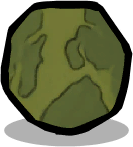
Polluted Dirt is a solid by-product element in Oxygen Not Included that behaves much like Dirt, but can slowly off-gas Polluted Oxygen when exposed to low pressure. It is commonly produced by sanitation and farming-related buildings, and it also appears as a resource in several creature and industrial loops. Because it can transform into gas over time, it is often treated as a storage and air-management problem as much as a material resource.
If stored at a pressure below 1.8 kg/tile, Polluted Dirt emits Polluted Oxygen and loses mass. The emission rate scales with the exposed mass, using the square root of the amount stored: 0.2 × sqrt(mass in kg), measured in g/s. In Spaced Out, this rate is reduced to 0.02 × sqrt(mass). Submerging Polluted Dirt in liquid or keeping it under at least 1.8 kg/tile of gas pressure prevents off-gassing. A good storage method is to keep it in a Storage Bin submerged under water, which blocks Polluted Oxygen production entirely.
Polluted Dirt is generated by a number of systems:
- Outhouses convert 13 kg Dirt into 19.7 kg Polluted Dirt per use, making them net positive in waste mass.
- Water Sieve produces 200 g/s Polluted Dirt as a by-product while cleaning Polluted Water with Sand or Regolith.
- Ethanol Distiller produces Polluted Dirt alongside Ethanol and Carbon Dioxide from Lumber.
- Pacus and their variants consume Algae and excrete Polluted Dirt.
- Sludge Press can process Polluted Mud into both Polluted Dirt and Polluted Water.
- It can also be harvested from renewable space points of interest in Swampy Ore Fields.
Polluted Dirt has several practical uses beyond storage:
- It can be converted back into Dirt in a Compost.
- Sage Hatches can eat it and produce Coal.
- Pokeshells can eat it and produce Sand.
- A Sublimation Station converts it directly into Polluted Oxygen, which can be useful when gas production is desired rather than avoided.
Because Polluted Dirt is a solid element, it also participates in normal heat exchange like other materials. Its thermal properties are not especially remarkable, but as with other mass-bearing tiles and debris, large piles can store enough heat to matter in industrial or biome-scale setups. The main gameplay concern is usually not temperature, but the fact that large stockpiles will continue to vent Polluted Oxygen unless sealed under sufficient pressure or submerged.
In practice, Polluted Dirt is best handled by deciding early whether it should be treated as a resource or as waste. If you want to keep it, store it underwater or in a pressurized room. If you want to use it, route it quickly into composting, creature feeding, or sublimation before it has time to become an air problem.
References to this (26)
- biomeSwampy Biome
- buildingAlgae Distiller
- buildingCompost
- buildingEthanol Distiller
- buildingOre Scrubber
- buildingOuthouse
- buildingWater Sieve
- buildingWood Tile
- critterHatch
- critterPokeshell
- diseaseDiarrhea
- diseaseRadioactive Contaminants
- elementAlgae
- elementDirt
- elementEthanol
- elementEthanol Gas
- elementPolluted Mud
- elementPolluted Oxygen
- elementPolluted Water
- elementRegolith
- elementSand
- foodMimillet
- foodSleet Wheat Grain
- geyserGeyser
- plantMealwood
- plantSeakomb