Throttling Valve
Overview
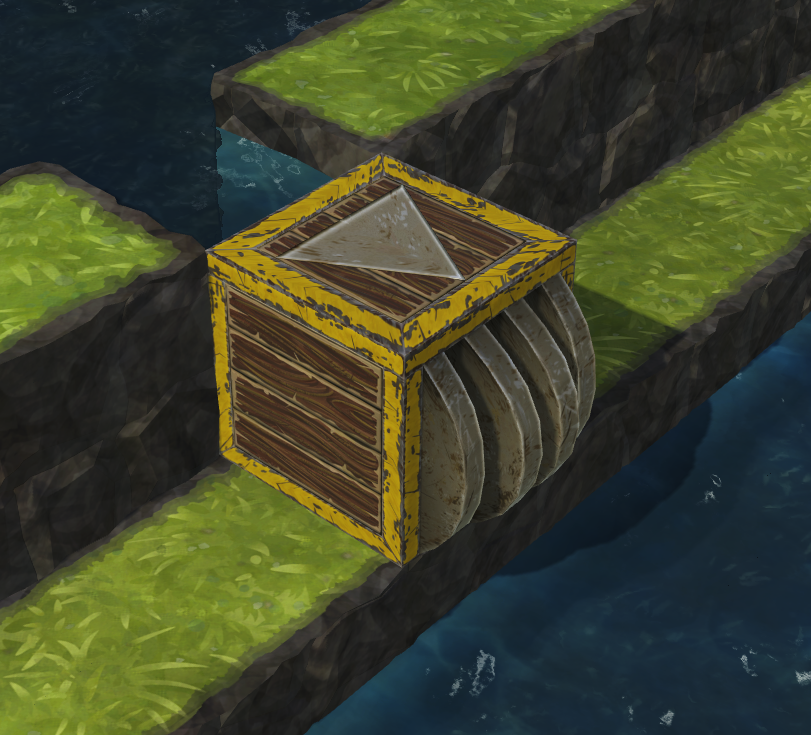
Throttling Valve is a building used to control and limit water flow in engineered waterways. It provides a configurable flow rate when left unconnected, and additional control options when connected to signal sources or logic relays. Throttling Valves are used in irrigation, sluices, reservoir filling strategies, and automated badwater diversion setups.
When used without a signal source, a Throttling Valve is set to a desired flow rate; the total flow is multiplied by the number of valves placed. When connected to a signal source, the valve gains an extra configuration for the valve state when the signal is off and a setting for a fixed lag before closing. The original setting (the basic desired flow) becomes the configuration for when the signal is on.
Throttling Valves are frequently combined with sensors and relays. In a badtide diversion system, a Contamination Sensor is set to trigger above a threshold (example: greater than 5%). Throttling Valves for the fresh water output are connected to a Relay and configured so the On value is 0 and the Off value is maximum, while Throttling Valves for the badwater output are connected to the Contamination Sensor with On set to maximum and Off set to 0. This configuration causes freshwater valves to close and badwater valves to open when contamination rises, and reverses when contamination drops.
In sluice and refill designs, a Throttling Valve can be connected to Depth Sensors and a Relay to control flow based on upstream and downstream water levels. An example setup sets an upstream Depth Sensor to greater than 0.70 m and a downstream Depth Sensor to less than 0.75 m, connects both sensors to a Relay configured as AND, and connects a Throttling Valve to that Relay. The valve’s On value is set to maximum flow (or reduced if that causes downstream flooding) and the Off value is set to a small flow to offset downstream evaporation. This allows the valve to open at high flow when upstream water is sufficient and downstream water is low, and otherwise permit only a trickle.
Place Throttling Valves at the bottom of reservoirs when reserving capacity; set the flow limit to less than the available current to allow filling during Temperate Seasons.
- Set the desired flow rate when not using a signal source; remember flow scales with the number of valves.
- When using a signal source, configure both the “signal on” and “signal off” settings and consider the fixed lag before closing.
- For contamination diversion, use a Contamination Sensor and Relay to switch freshwater and badwater Throttling Valves between maximum and zero flow.
- For controlled refills, combine upstream and downstream Depth Sensors with an AND Relay; set On to a high flow and Off to a small trickle to balance refill speed and evaporation.
- Install valves at reservoir bottoms and limit their flow so reservoirs can fill reliably during Temperate Seasons.
Trivia: valves have a long history as devices to control water, evolving from ancient manual valves to modern remotely controlled mechanisms; household taps and toilet flushes are everyday examples of valves in use.
Other entities of this type
- Advanced Breeding Pod
- Agora
- Aquatic Farmhouse
- Aquifer Drill
- Aquifer Drill
- Badwater Discharge
- Badwater Dome
- Badwater Pump
- Badwater Rig
- Bakery
- Banners
- Banners/Custom Banner Images
- Barrack
- Barriers
- Beaver Bust
- Beaver Statue
- Beehive
- Bell
- Bench
- Bot Assembler
- Bot Part Factory
- Brazier
- Breeding Pod
- Builder Flag (Obsolete)
... +162 (see sidebar for full list)