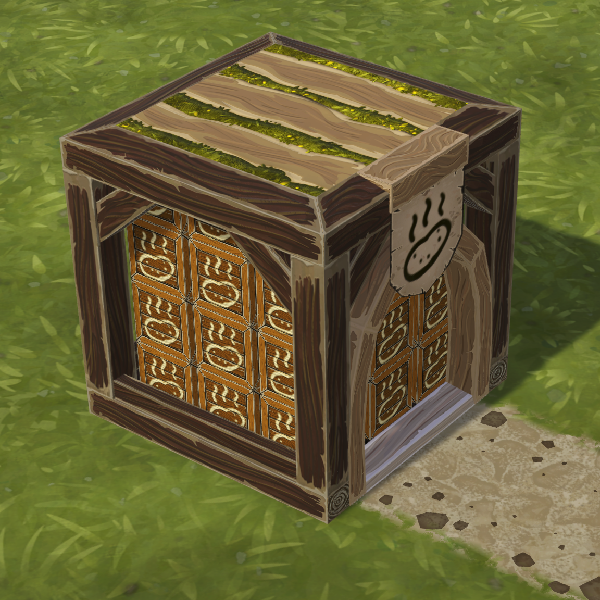
Potatoes
Overview
Potatoes are a cultivated food crop in Timberborn that can be planted and harvested through a Farmhouse. They serve as a mid-game food option that adds variety to a settlement’s diet while occupying farming plots and requiring processing before consumption.
Potatoes produce a maximum of 0.66 food per plot per day, compared to Carrots at 0.75 food per plot per day, making potatoes less space efficient than carrots. Potatoes take 6 days to grow. A Grill is required to process raw potatoes into edible food, and Grills have a throughput limit that constrains how many potato plots a given number of Grills can support. Under the assumption of a standard 16-hour workday and 100% work efficiency, a single Grill can process 30 potatoes per day. Using that idealized throughput, a single Grill would be able to process the yield from up to 180 potato plots; this 180-plot figure is an absolute theoretical upper limit and does not account for real-world in-game inefficiencies.
Potatoes are generally regarded as a worthwhile addition to food production in the mid-game because they diversify available food sources even though they require more worker time and space than carrots. Because Grills can become a bottleneck, it is important to balance the number of potato plots against your available processing capacity to avoid warehouses filling with unprocessed raw potatoes.
- Potatoes are planted and harvested via the Farmhouse.
- Growth time: 6 days.
- Food yield: 0.66 food per plot per day (maximum).
- Comparative note: Carrots yield 0.75 food per plot per day, so carrots are more space efficient.
- Processing: Grills convert raw potatoes into edible food; a single Grill can process up to 30 potatoes/day under an ideal 16-hour, 100% efficiency workday.
- Practical limit: The idealized processing capacity corresponds to roughly 180 potato plots per Grill as an upper bound; expect lower practical capacity due to inefficiencies.
- Gameplay tip: Monitor warehouse stock of raw potatoes and scale either Grill capacity or farm plots to maintain steady throughput and avoid labor waste.